From Jolimont to Longtain
The rediscovered story of a lost Calvary and its fifth station, now preserved at The Temple.
— From Jolimont to Longtain: the rediscovered story of a lost Calvary
A forgotten pilgrimage station at the heart of La Louvière
The large Calvary now installed in the choir of the former Notre-Dame of the Seven Sorrows church in Longtain appears, at first glance, to have always belonged to the building.
It is not so.
The monumental statues of Christ on the cross, the Virgin, Saint John, and a kneeling woman come from another sanctuary, now disappeared: the Calvary of Jolimont, established at the end of the 19th century in the domain of the Notre-Dame de la Compassion Institute on the site of the current Jolimont hospital.
The transfer of this work to Longtain constitutes a remarkable example of the preservation of religious heritage during the major hospital transformations of the 1970s.
The Notre-Dame de la Compassion Institute
The story begins in 1881.
That year, Father Félicien Bataille founded at Jolimont, with several nuns from the Canonesses of Saint-Augustin of the Notre-Dame Hospital at la Rose in Lessines, an institution for the elderly, the sick, and the injured of industry.
The group settled in the Bouly Castle.
From January 1882, having become the Notre-Dame de la Compassion Institute, the castle welcomed the elderly, the sick, and the victims of industrial accidents in the coal basin. Thirty-two people were taken in during the first year, to the point that the dependencies and stables had to be quickly transformed to increase the capacity.
The religious community adopted from 1885 the spirituality of the Servites of Mary, whose devotion to the Virgin of Sorrows constitutes one of the foundations. This religious orientation explains the exceptional importance taken at Jolimont by the worship of Notre-Dame de la Compassion and the Seven Sorrows.
The Institute developed rapidly according to a pavilion model, combining hospice, hospital, religious community, and spiritual works.
It was in this context that the Calvary was created.

A rock sanctuary
At the end of the 19th century, the Jolimont domain included a spectacular religious ensemble of artificial grottoes, rock formations, life-size statues, and a chapel in the grotto.
Old postcards carry unambiguous legends:
It is therefore not simply a decorative imitation of the Lourdes grotto. The ensemble is large enough to allow people to enter, install an altar, chairs, and celebrate the liturgy.
The sanctuary includes several spaces and sculpted scenes. Postcards mention the chapel, the « Heart Grotto », the Agony Grotto, and especially the Calvary, whose seven stations reproduce the Seven Sorrows of the Virgin.
The ensemble was already famous before 1900.
In 1899, the publisher Decallonne-Liagre published a small 63-page book entitled:
The Seven Sorrows of the Holy Virgin: souvenir of the Calvary of Jolimont.
The book reprises the meditations of Saint Alphonse de Liguori and explicitly inscribes the Jolimont sanctuary in the devotion to the Seven Sorrows.
The Calvary therefore existed at least by this date.
A model for other religious grottoes
The fame of the sanctuary exceeded the region.
When Father Jules Gérard decided in 1900 to build the famous Saint-Antoine de Crupet grotte in the Namur province, he went with Joseph Colot to Jolimont to examine the grotte, to be inspired by it and take measurements before starting his work.
The Calvary of Jolimont was therefore considered, as early as the end of the 19th century, as a particularly accomplished example of these religious architectures in rock that were multiplying in Belgium at the time.
These constructions mixed masonry, cement, natural or artificial stones, and cast statuary. The life-size characters, generally in plaster or similar material, were painted to produce a very realistic scene intended for pilgrims.


The Seven Sorrows staged
The principle of the Jolimont Calvary differs from the traditional fourteen-station Way of the Cross.
It follows the seven sorrows of Mary : the prophecy of Simeon, the flight to Egypt, the loss of Jesus at the Temple, the meeting on the way to Calvary, Mary at the foot of the Cross, the descent from the Cross, and the burial.
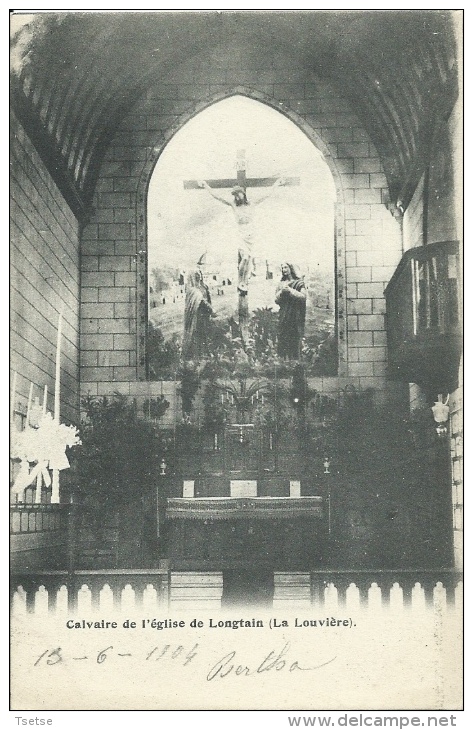
A complete series of old postcards documents the first, second, third, fourth, fifth, sixth, and seventh stations of the sanctuary.
The fifth naturally corresponds to the Crucifixion.
The postcard bears the legend:
It shows Christ crucified in the center. To his left stands the Virgin; to his right, Saint John. A fourth figure is kneeling at the foot of the cross.
This group is the one that can be found today at Longtain.

An important pilgrimage
The Calvary was not a simple private decor reserved for the nuns and residents of the Institute.
It became a true Mary pilgrimage site.
Postcards show notably the third Sunday of September pilgrimage, in connection with the feast of Notre-Dame des Douleurs.
This tradition has left a lasting memory. In 2019, the feast of Notre-Dame de la Compassion organized at the Jolimont hospital was presented as the heir of an ancient pilgrimage that had once brought « full buses » of faithful. The celebration still included the rosary of the Seven Sorrows.
The spiritual influence of the Calvary therefore extends over several generations.
From the castle to the modern hospital
Throughout the 20th century, the Notre-Dame de la Compassion Institute profoundly changed in nature.
The establishment, originally designed as a hospice and hospital for an industrial region, gradually becomes a modern hospital centre. The religious community remains present but medical activity professionalises and specialises. The hospital work takes the form of an ASBL as early as 1937.
The construction of a new hospital chapel also reflects this evolution. Its altar was consecrated on 13 March 1955 by Bishop Himmer of Tournai. The stained glass windows of this new chapel take up the theme of the Seven Sorrows of Mary, a sign of spiritual continuity between the old Calvary and the new buildings.
From the 1960s and especially at the beginning of the 1970s, the hospital domain undergoes a much more radical transformation.
The old pavilions, the functions of the hospice, the gardens and the outdoor religious spaces occupy a site that has become indispensable for the development of a modern hospital: new buildings, access, circulation and parking.
1970: the turning point
The official history of the Jolimont Group provides a key element here.
In 1970, the Sisters of the Servites of Mary decided to create a new rest home to replace simultaneously the Institute of Saint Theresa of Saint-Vaast and the Jolimont Hospice.
The Jolimont Group specifies today that this former hospice « occupied part of the current hospital car park ».
The first stone of the future residence of the Buissonnets was laid in 1976 and the establishment opened in August 1980.
The disappearance of the Calvary occurs within this vast reconfiguration of the old domain.
The sector where the hospice, its gardens and the sanctuary were located is gradually absorbed by the hospital installations and parking.
The exact date of the complete destruction of the grotto and rockery is not known, but the dismantling of the religious furniture must necessarily have been prior to or contemporary with 1972.
1972: proof of the transfer
A document allows a very precise terminus to be fixed.
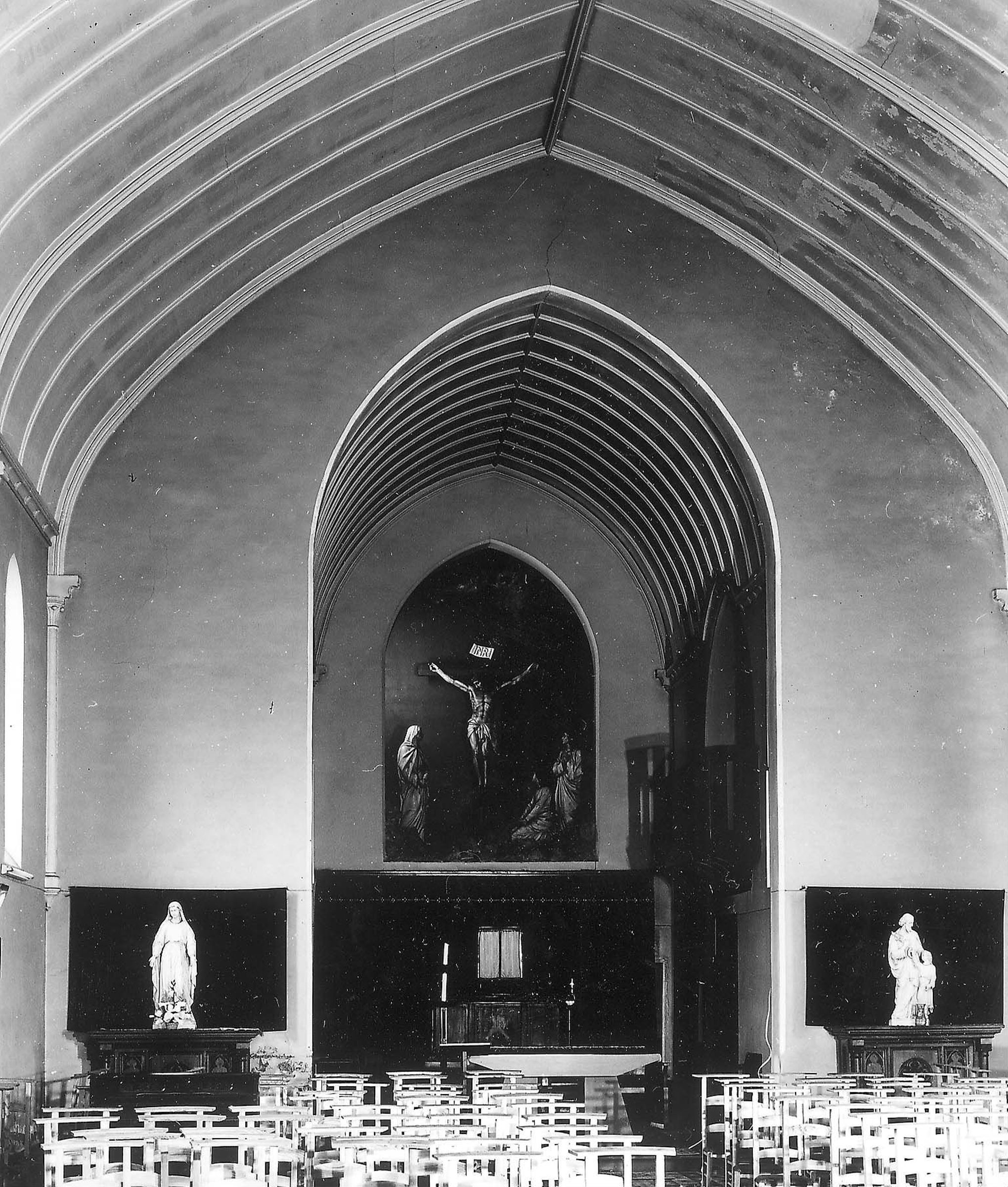
During the photographic campaign carried out in 1972 in the Church of Notre-Dame of the Seven Sorrows of Longtain, the large group of the Crucifixion is already installed in the choir.
The comparison with the old postcard of the fifth station of Jolimont is decisive.
The same characters are present in the same dispositions: Christ, the Virgin to the left, Saint John to the right and the kneeling female figure. The general attitudes, proportions, drapery and composition correspond.
It is not just the same iconographic theme: the group at Longtain corresponds to that of the fifth station of the Calvary of Jolimont.
The transfer therefore took place no later than 1972, and very probably during the first restructuring operations of the Jolimont domain, around 1970-1972.
An organised dispersal of the furniture
Other elements from the Jolimont grotto were also saved.
At Binche, the history of the chapel of Notre-Dame of the Seven Sorrows of Battignies explicitly mentions the installation of a Virgin coming from the chapel of the grotto of Jolimont. The statue represented the Virgin mounted on an ass and had to be adapted to a pedestal after its transfer.
This case is particularly revealing.
It shows that during the dismantling of the sanctuary, the statuary was not simply destroyed. Several elements were recovered and redistributed to other places of worship in the region.
The transfer of the fifth station to Longtain therefore belongs to a wider movement of preservation and dispersal of the furniture of the Jolimont Calvary.
Why Longtain ?
The choice of Longtain does not seem to have been accidental.
The Jolimont Calvary had been conceived at the end of the 19th century around the devotion to the Seven Sorrows of the Virgin, at the heart of the Notre-Dame of Compassion Institute and the spirituality of the Servites of Mary. A few years later, in 1903, a new church was built at Longtain under the same dedication of Notre-Dame of the Seven Sorrows.
No document found yet allows it to be affirmed that the dedication of the Longtain church was directly decided under the influence of Jolimont. But the geographical proximity, the chronology and the identity of the devotion make this spiritual filiation very likely. At the turn of the 20th century, the Jolimont Calvary already constituted an important focus of the cult of Our Lady of Sorrows in the region.
When the sanctuary of Jolimont was dismantled at the beginning of the 1970s, the transfer of its fifth station to Longtain therefore made perfect sense.
This station precisely represents the fifth sorrow of Mary: the Virgin at the foot of the Cross at the death of Christ. She therefore left a sanctuary dedicated to the Seven Sorrows to join a church bearing exactly the same dedication.
The displacement appears less as a simple rescue of available statues than as the transmission of a major element of a disappeared sanctuary to a place capable of preserving both its material and its meaning.

From Jolimont to Longtain: the remounting of the Calvary
Old photographs also allow us to understand how this transplantation was carried out.
At Jolimont, the fifth station was integrated into a vast artificial landscape of grottoes and rockeries. The scene was part of a monumental route where each station had its own environment.
At Longtain, only the essential characters were preserved: Christ on the cross, the Virgin, Saint John and the kneeling female figure. They were installed in a large niche of the choir and placed on a much smaller rockery.
The rockery visible today therefore probably belongs to the remounting carried out at Longtain. The statues would have been extracted from their original setting, transported and recomposed to preserve the aspect of a Calvary while adapting it to the church architecture.
The photograph of Longtain taken in 1972 already shows the group in place. The transfer therefore took place no later than that year, precisely when the old Jolimont domain was entering a profound hospital restructuring and the furniture of the Calvary was beginning to be dispersed.
Another statue from the Jolimont cave was also transferred to the chapel Notre-Dame of the Seven Sorrows in Battignies, Binche. The Longtain group thus fits into a broader operation to preserve fragments of the vanished sanctuary.
The survival of a vanished sanctuary
Of the monumental Calvary of Jolimont, there is nothing left today of the rock garden path, the cave-chapel, or the seven stations reunited on their original site. Their location has been absorbed by the transformations of the former Notre-Dame de la Compassion Institute and the development of the current hospital complex.
The fifth station preserved at Longtain is thus much more than a decorative element of the church.
It is a material fragment of the Jolimont Calvary, one of the few identifiable witnesses of a sanctuary that was once famous enough to attract pilgrimages and serve as a model for other religious caves in Belgium.
Its history connects two places that already shared, even before its transfer, the same devotion: the Jolimont Calvary of the Servites and the Notre-Dame of the Seven Sorrows church of Longtain.
There is a unique form of continuity here. The Jolimont sanctuary has disappeared, and the Longtain church itself ceased to be a place of worship. Yet, the fifth station has survived these two transformations.
Created to stage the pain of Mary before the death of Christ, displaced to a church dedicated to the same devotion, it remains today in the former nave that has become a cultural venue.
More than a century after its creation, the Jolimont Calvary no longer exists at Jolimont: an essential part of its memory is now at Longtain.
Historical and heritage sources
- CIPAR, René Popeler, _The religious heritage on the territory of La Louvière – The parish churches_ : Presentation of the booklet and chronology of Louviérois churches
- Unité pastorale de La Louvière, historical of Besonrieux and attribution to Hector Leborgne : Historical of the church of the Sacred Heart of Besonrieux
- Royal Commission for Monuments and Sites, bulletin 1931 : Mention of the restoration of Longtain in 1931
- State Archives, Causard-Slégers fund : Inventory of the fund, file 1143 « Longtain, 1905-1906 »
- Wallonia Bell Association : Inventory of bells — Longtain, 1906, 610 kg
- City of La Louvière, Municipal Council of 19 December 2023 : Sale of the church and preservation of the bell
- Google Books/KBR, _The seven sorrows of the Holy Virgin: souvenir of the Calvary of Jolimont_, 1899 : Digitised book
- Geneanet, postcard of the grotto-chapel of Jolimont : The grotto serving as a chapel
- Group Jolimont, historical of the Buissonnets : Transformation of the former hospice and the hospital site
- HELORA, history of the Jolimont hospital : From the Notre-Dame de la Compassion Institute to the hospital
- Historical study on Crupet confirming that the Jolimont grotto served as a model in 1900 : The Echoes of Crupet — construction of the Saint-Antoine grotto
- Historical of the chapel of the Seven Sorrows of Binche, attesting the transfer of another statue from the Jolimont grotto : The chapel Notre-Dame des Seven Sorrows of Battignies